
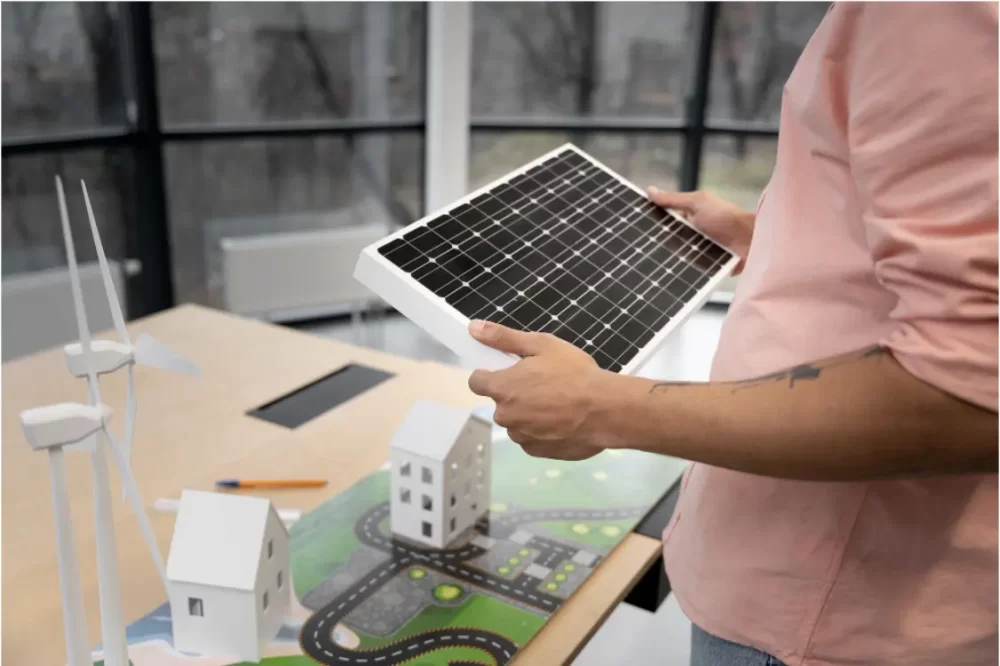
Solar panels in Malaysia work by converting sunlight into electricity through photovoltaic (PV) cells. Under Malaysia’s new Solar ATAP programme (effective January 2026), homeowners can install systems up to 100% of their maximum demand with no fixed quota — and export excess energy to the grid at a retail-linked rate. Pairing your solar panels with a BESS (Battery Energy Storage System) at home maximises savings and moves you closer to full energy independence.
Rising electricity tariffs. A new government solar programme. Electric vehicles entering Malaysian driveways. And a growing national ambition to reach 70% renewable energy by 2050.
2026 is not just a good time to go solar in Malaysia — it may be the most strategically advantageous year yet.
At Amcharge, we help Malaysian homeowners and businesses adopt clean energy with confidence — from solar panel installation to battery storage (BESS Malaysia) installation. This guide covers everything you need to know to make the right decision for your home.
1. Why Go Solar in Malaysia in 2026?
The case for solar energy in Malaysia has never been stronger. Here is why homeowners across the country are making the switch:
- TNB electricity tariffs have increased, making solar energy in Malaysia more financially attractive than ever
- Malaysia’s solar irradiance averages 4.5 to 5.5 peak sun hours per day — among the highest in Southeast Asia
- The new Solar ATAP programme (replacing NEM) removes previous quota restrictions, opening solar access to all eligible consumers
- Solar panel technology has improved — modern panels are more efficient, more durable, and more affordable than a decade ago
- The rise of electric vehicles in Malaysia means homeowners can charge their EV overnight using stored solar energy via a BESS
- With proper system sizing, Malaysian homeowners can reduce electricity bills by up to 90%
| 🌱 Amcharge’s Mission We are committed to helping Malaysian households and businesses transition to clean energy — not just by selling solar panels, but by designing complete energy systems that include solar installation, BESS Malaysia solutions, and EV charger installation. One provider, one integrated system. |
2. How Do Solar Panels Work?
Before diving into specifications, it helps to understand the basics of solar power in Malaysia.
Solar panels are made up of photovoltaic (PV) cells that convert sunlight directly into direct current (DC) electricity. An inverter then converts this to alternating current (AC), which powers your home appliances.
Any excess electricity generated by your solar panels can be:
- Stored in a Battery Energy Storage System (BESS) for use at night or during outages
- Exported back to the national grid under Malaysia’s Solar ATAP programme for energy bill credits
3. Types of Solar Panels Available in Malaysia (2026)
Not all solar panels perform the same. In 2026, three main types are used for residential solar installation in Malaysia:
Monocrystalline Panels — Best for Most Malaysian Homes
- Efficiency: 18 to 22%
- Lifespan: 25 to 30 years
- Pros: Highest efficiency, sleek black appearance, excellent performance in Malaysia’s partial-cloud conditions
- Best for: Homes with limited roof space or high energy demands
- Amcharge recommendation: Our first choice for most residential solar panel at home projects
Polycrystalline Panels — Budget-Friendly Option
- Efficiency: 15 to 17%
- Lifespan: 20 to 25 years
- Pros: Lower upfront cost
- Cons: Slightly lower efficiency, larger physical footprint
- Best for: Larger roofs with budget constraints
Thin-Film Panels — For Specialist Applications
- Efficiency: 10 to 13%
- Pros: Lightweight, flexible, aesthetically minimal
- Cons: Shorter lifespan and lower output per square metre
- Best for: Curved roofs, BIPV (Building-Integrated PV), or design-forward projects

4. Key Factors to Consider When Choosing Solar Panels
When evaluating solar panels for your home, here is what actually matters:
Efficiency Rating
Higher efficiency panels produce more electricity per square metre — critical for Malaysian homes with limited roof space. Tier-1 monocrystalline panels from reputable brands consistently deliver 20%+ efficiency under local tropical conditions.
Durability and Warranty
Malaysia’s climate is demanding — intense UV exposure, heavy rainfall, and high humidity year-round. Choose panels with:
- Product warranty: 10 to 15 years minimum
- Performance warranty: 25 years or more
- IEC certification for tropical climate resilience
At Amcharge, we only supply Tier-1 certified solar panels tested and proven for Malaysia’s climate. Every system we install comes with long-term performance guarantees.
Cost Per Watt vs Long-Term Value
Cheaper panels may save money upfront but often underperform over a 25-year lifespan. Evaluate cost per watt alongside the panel’s efficiency degradation rate (the best panels lose less than 0.5% efficiency per year). When assessing the total cost of a solar installation in Malaysia, consider: panel quality, inverter quality, installation workmanship, and after-sales support.
Aesthetics
Modern solar panels at home come in black, dark blue, and frameless all-black designs. If your home’s exterior appearance matters, all-black monocrystalline panels offer the cleanest visual integration.
Installer Quality
Even the best solar panel will underperform with poor installation. Choose a SEDA-registered, experienced provider. Amcharge offers:
- Certified solar installation teams with full technical credentials
- Roof structural assessment before every installation
- Complete Solar ATAP application handling with SEDA and TNB
- Real-time system monitoring and post-installation support
- Maintenance packages to protect your long-term solar investment

5. Malaysia’s New Solar Policy: Solar ATAP (2026 Update)
Malaysia’s Net Energy Metering (NEM) scheme officially ended in June 2025. In its place, the government introduced the Solar Accelerated Transition Action Programme — known as Solar ATAP — which became effective from 1 January 2026.
Solar ATAP was designed to address the key limitations of NEM: fixed quotas, capacity restrictions, and limited participation windows. Here is what has changed:
| Feature | NEM (ended June 2025) | Solar ATAP (from Jan 2026) |
|---|---|---|
| Export Mechanism | 1-to-1 energy offset | System Marginal Price (SMP) |
| Capacity Limit | Up to 80% of max demand | Up to 100% of max demand (or 1MW) |
| Quota | Fixed quota, often full | No fixed quota — open to all |
| Contract Tenure | No fixed term | 10-year contract |
| Application Platform | SEDA Malaysia portal | SEDA Malaysia portal |
| Residential Export Rate | ~RM 0.57/kWh offset | ~RM 0.27-0.37/kWh (retail-linked) |
| Best Strategy | Maximise export | Maximise self-consumption + BESS |
What Solar ATAP Means for You in Practical Terms
- No quota limits: Any eligible consumer can apply — no more waiting for quota slots to open
- Larger systems allowed: Install up to 100% of your maximum demand (previously capped at 80%) or up to 1MW
- Export rates for residential users are retail-linked, approximately RM 0.27 to RM 0.37 per kWh depending on your consumption tier
- Commercial users receive export credits based on the System Marginal Price (SMP) — typically RM 0.20 to RM 0.40 per kWh
- 10-year contract tenure: After the contract period, the system reverts to pure self-consumption mode
- Applications are submitted through the SEDA Malaysia online portal after full system installation and commissioning
| 💡 ATAP Strategy Tip Under Solar ATAP, self-consumption is more valuable than export. The smartest approach is to size your system to maximise daytime self-consumption, pair it with a BESS Malaysia solution for nighttime use, and export only what you cannot consume or store. If you also drive an electric vehicle in Malaysia, charging your EV from solar energy makes the economics even more compelling. |
6. BESS Malaysia: Is Battery Storage Worth It in 2026?
Battery Energy Storage Systems (BESS) have become an increasingly important part of residential solar installations in Malaysia — and for good reason.
Under Solar ATAP, the export rate for excess solar energy is lower than the old NEM 1-to-1 offset. This means every unit of solar energy you consume yourself is worth more than every unit you export. A BESS captures excess daytime generation and makes it available for evening use — turning what would have been low-value exported energy into high-value self-consumption.
Key Benefits of BESS Malaysia for Homeowners
- Backup power during grid outages and blackouts — particularly valuable in areas with unstable supply
- Store peak-hour solar generation for evening consumption — the highest-demand time in most Malaysian households
- Reduce or eliminate your TNB bill entirely when combined with a well-sized solar system
- Power your home and your electric vehicle from stored clean energy
- Greater energy independence — insulation from future tariff increases
Popular BESS options in Malaysia include the Tesla Powerwall (13.5 kWh), Huawei Luna2000 (5 to 15 kWh scalable), and BYD Battery-Box. Amcharge supplies, installs, and integrates BESS Malaysia solutions as part of a complete solar system design.
7. Calculate Your Solar Needs
The right solar system size depends on several factors specific to your property and consumption patterns:
- Monthly electricity usage in kWh (check your TNB bill)
- Roof size, pitch, and orientation — south-facing is optimal for solar power in Malaysia
- Your Solar ATAP eligibility and capacity limit based on maximum demand
Practical Sizing Example
A typical Malaysian household uses 400 to 700 kWh per month. To offset this usage effectively under Solar ATAP, most homes will need a 5 kW to 8 kW solar system, requiring approximately 12 to 20 panels depending on individual panel wattage.
Adding a 10 kWh BESS allows you to store excess midday generation and use it through the evening peak — eliminating most or all grid electricity purchases.
| 🧮 Not Sure What Size You Need? Amcharge provides a complimentary solar assessment for every new inquiry. We analyse your TNB bills, inspect your roof, calculate your Solar ATAP capacity limit, and design a system that is optimised for your specific usage — not a generic estimate. Contact us at amcharge.my to get started. |
8. Why Choose Amcharge for Solar Installation in Malaysia?
At Amcharge, we do not just install solar panels — we design complete, integrated energy systems for the long term. Our full-service offering covers every stage of your solar journey:
- Free consultation and on-site solar assessment
- Custom system design optimised for Solar ATAP, self-consumption, and your lifestyle
- Supply of Tier-1 solar panels, premium inverters, and BESS Malaysia solutions
- Certified, experienced solar installation teams
- Complete Solar ATAP application handling with SEDA Malaysia and TNB
- Post-installation monitoring, maintenance packages, and long-term support
We have helped hundreds of Malaysian homeowners and businesses reduce their energy costs, future-proof their properties against rising tariffs, and move toward genuine energy independence. We can help you too.
Make the Switch with Confidence
Going solar in Malaysia in 2026 is easier, smarter, and more rewarding than ever before. Solar ATAP has removed the barriers that once held prospective solar users back. Battery storage has become practical and cost-effective. There has never been a better time to invest in solar energy in Malaysia.
| 🚀 Ready to Start Your Solar Journey with Amcharge? Contact Amcharge today for a free personalised solar assessment. We will review your energy usage, design a system around your goals, and handle everything Solar ATAP installation. Visit amcharge or call us [+6012-970 2368] to speak with a solar energy specialist today. |